2026.08.19
Blog
How Starting Torque Affects Air Compressor Motor Performance
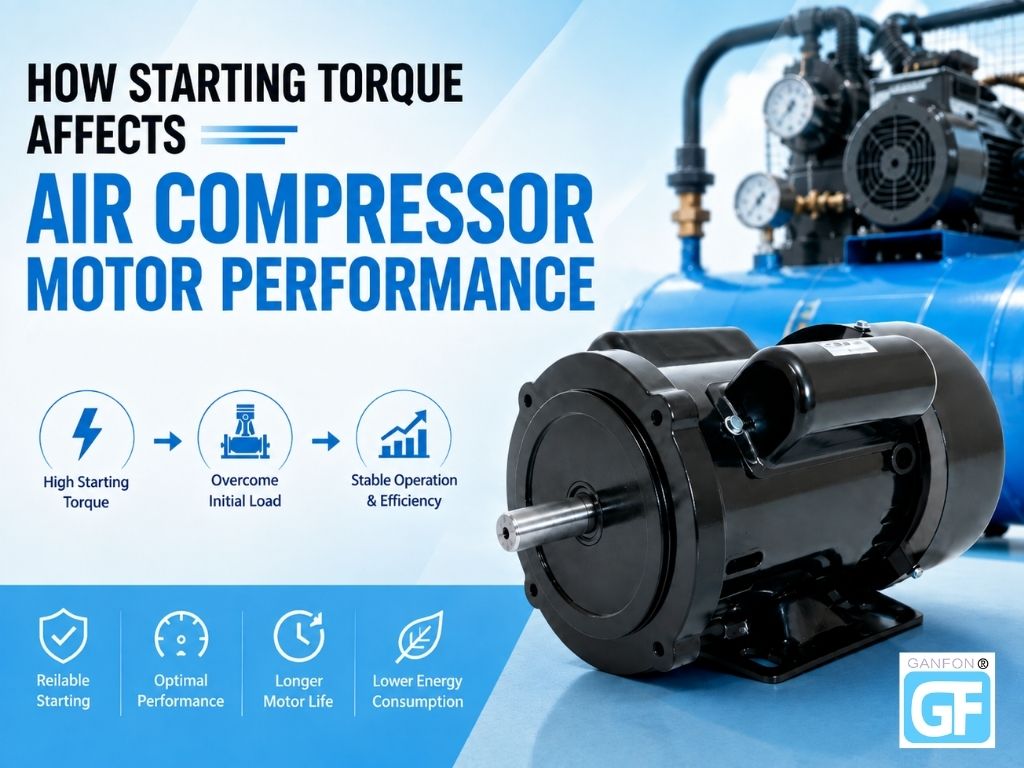
An air compressor motor must do more than keep a compressor running at its rated speed. One of the most demanding moments occurs during startup, when the motor must overcome the inertia of the compressor mechanism and accelerate the system to normal operating speed. If the available starting torque is insufficient, the compressor may start slowly, draw excessive current, overheat, or fail to start under demanding load conditions.
For equipment manufacturers, understanding starting torque is therefore an important part of selecting an air compressor motor. The correct motor must match not only horsepower and voltage requirements but also the actual starting conditions, operating cycle, and compressor load. With extensive experience in induction motor applications, GANFON develops motor solutions for air compressor equipment where reliable startup and stable operation are essential.
What Is Starting Torque in an Air Compressor Motor?
Starting torque is the rotational force a motor produces from standstill. Before an air compressor reaches normal operating speed, the motor has to accelerate several mechanical components while overcoming friction, inertia, and resistance within the compression system.
This makes startup considerably different from normal running operation. Once the compressor reaches operating speed, the torque required to maintain rotation may be lower and more stable. During startup, however, insufficient torque can prevent the system from accelerating efficiently.
For this reason, the rated horsepower of an air compressor motor tells only part of the story. Two motors with similar rated output may behave differently during startup depending on their motor design and torque characteristics.
Why Air Compressors Require Strong Starting Performance
Air compressors can present demanding starting conditions because the motor must bring the compressor mechanism up to speed within a relatively short period. Depending on the compressor design and starting method, startup resistance may be affected by mechanical inertia, the pressure condition of the compression system, ambient temperature, and the condition of the driven components. Some compressor systems use an unloading mechanism to reduce the load during startup. Air compressors may require adequate or high starting torque depending on their compressor design and starting conditions.
A motor with suitable starting torque helps the compressor:
- Accelerate to operating speed more reliably
- Reduce the risk of stalled or unsuccessful starts
- Handle repeated starting cycles more consistently
- Maintain stable performance as operating conditions change
This is particularly important for workshop and light industrial air compressors that may cycle on and off repeatedly as compressed-air demand changes.
What Happens When Starting Torque Is Too Low?
When an air compressor motor cannot produce enough torque at startup, acceleration takes longer. The motor may remain in a high-current starting condition for an extended period, increasing electrical and thermal stress.
Common warning signs may include slow acceleration, humming without reaching normal speed, repeated protection trips, or unusually high motor temperature after frequent starting cycles.
| Starting Issue | Possible Effect | What to Check |
|---|---|---|
| Slow acceleration | Longer high-current period and additional motor heating | Motor torque characteristics and compressor load |
| Motor stalls during startup | Compressor cannot reach operating speed | Starting torque, supply voltage, and mechanical resistance |
| Frequent overload trips | Interrupted compressor operation | Motor sizing, start frequency, and system condition |
| Excessive temperature rise | Accelerated insulation and component aging | Starting duration, ventilation, load, and voltage |
These symptoms do not automatically mean that the motor is defective. Compressor condition, electrical supply, wiring, starting components, and system pressure should also be evaluated before identifying the root cause.
Starting Torque and Horsepower Are Not the Same
One common motor-selection mistake is assuming that horsepower alone determines whether a motor is suitable for an air compressor. Horsepower describes the motor's mechanical output under defined operating conditions, while starting torque describes its ability to produce rotational force before reaching normal operating speed.
Starting torque is determined by the motor's electromagnetic design and starting characteristics, not simply by its rated horsepower.
An air compressor motor therefore needs to be evaluated according to both its rated output and its starting characteristics. Simply selecting a higher-horsepower motor without considering the compressor design does not automatically produce the best result.
Equipment manufacturers should consider the complete drive system, including compressor type, mechanical load, transmission method, required operating speed, electrical supply, and expected start-stop frequency.
How Frequent Start-Stop Cycles Affect Motor Selection
Many air compressors do not operate continuously at a constant load. Instead, the motor may stop and restart according to pressure demand. Each restart creates another period of high electrical and mechanical stress.
When starts occur frequently, motor selection becomes especially important because repeated acceleration can increase temperature faster than the motor can dissipate heat. A motor suitable for the application must therefore provide adequate starting performance while also operating within acceptable thermal limits.
When specifying a motor for a compressor with frequent cycling, consider:
- Length of each operating cycle
- Time available for motor cooling
- Ambient temperature and ventilation conditions
- Compressor load at the moment of restart
Evaluating the duty pattern during the equipment design stage can help prevent overheating, nuisance trips, and premature motor wear after the compressor enters service.
Power Supply Conditions Also Affect Starting Performance
Even a properly selected air compressor motor may experience poor starting performance if the electrical supply cannot maintain adequate voltage during startup. Because motor starting current can be substantially higher than normal running current, inadequate wiring, excessive voltage drop, or an unsuitable power source can reduce the torque available during acceleration.
This makes electrical compatibility an essential part of motor selection. Voltage, frequency, wiring capacity, protective devices, and the characteristics of the available power supply should all be checked against the motor and compressor requirements.
For equipment intended for different export markets, these considerations become even more important because local electrical standards and available power supplies may vary.
How to Select an Air Compressor Motor for Reliable Startup
The most effective approach is to select the motor according to the compressor's actual operating conditions rather than relying on a single specification. Starting torque is important, but it should be evaluated together with normal running performance and long-term reliability.
| Selection Factor | Why It Matters |
|---|---|
| Starting Torque | Determines whether the motor can accelerate the compressor reliably from standstill |
| Rated Output | Must match the mechanical power required during normal compressor operation |
| Voltage & Frequency | Must correspond to the intended electrical supply |
| Start-Stop Frequency | Frequent starts increase thermal and electrical stress |
| Operating Environment | Temperature, ventilation, dust, and installation conditions influence motor reliability |
| Mechanical Integration | Shaft, mounting, speed, and transmission requirements must match the compressor design |
Considering these factors together helps equipment designers avoid both undersizing and inappropriate oversizing while achieving reliable startup and stable compressor operation.
GANFON Air Compressor Motor Solutions
GANFON provides a single-phase induction motor for air compressor applications developed for residential and light industrial compressor systems. The motor is designed with high starting torque to support heavy-load startup and stable compressor operation.
GANFON's air compressor motor solution is also designed to support applications involving repeated start-stop operation, depending on the specific operating cycle and equipment requirements. Customized specifications can also be discussed according to equipment requirements.
By considering starting characteristics together with rated output, operating cycle, and equipment integration, GANFON supports manufacturers in selecting motor configurations that better match real compressor operating conditions.
Frequently Asked Questions About Air Compressor Motor Starting Torque
Q1. Why does an air compressor need high starting torque?
An air compressor motor must accelerate the compressor mechanism from standstill while overcoming mechanical inertia and system resistance. Adequate starting torque helps the compressor reach operating speed reliably and reduces the risk of stalled or prolonged starts.
Q2. Does a higher-horsepower motor always provide better compressor startup?
No. Horsepower alone does not determine startup suitability. Motor torque characteristics, compressor load, supply voltage, operating speed, and mechanical integration must also be considered. The correct motor is one that matches the complete compressor system rather than simply providing the highest rated output.
Q3. Why can frequent compressor starts shorten motor life?
Each startup exposes the motor to increased electrical current and thermal stress. When start-stop cycles occur too frequently, heat may accumulate faster than it can dissipate. Proper motor selection, adequate cooling, and suitable compressor control settings help reduce this stress.
Related Articles
For further information about induction motor characteristics, applications, and long-term reliability, explore these related GANFON articles:
- Induction Motors: Comprehensive Guide — Learn about induction motor operating principles, motor types, starting characteristics, and common industrial applications.
- Top Applications of Single-Phase Induction Motors in Industrial and Commercial Equipment — Explore how single-phase induction motors are applied in air compressors, pumps, ventilation equipment, and other machinery.
- What Factors Affect the Lifespan of an Induction Motor? — Understand how load, temperature, electrical conditions, bearings, and maintenance affect long-term motor reliability.
Conclusion
Starting torque has a direct influence on how reliably an air compressor motor can bring the compressor from standstill to normal operating speed. Insufficient starting performance can result in slow acceleration, unsuccessful starts, additional heating, and unnecessary stress on both the motor and compressor system.
For this reason, selecting an air compressor motor should involve more than comparing horsepower ratings. Starting torque, duty cycle, start-stop frequency, electrical supply, operating environment, and mechanical compatibility should all be considered as part of the complete equipment design.
If you are developing or upgrading an air compressor and need a motor solution matched to your operating requirements, contact GANFON to discuss your application. Our team can provide technical guidance and customized motor specifications to support reliable startup and stable compressor performance.

