2026.09.09
Blog
The Importance of Portable Ventilation Fans for Workplace Safety and Air Quality
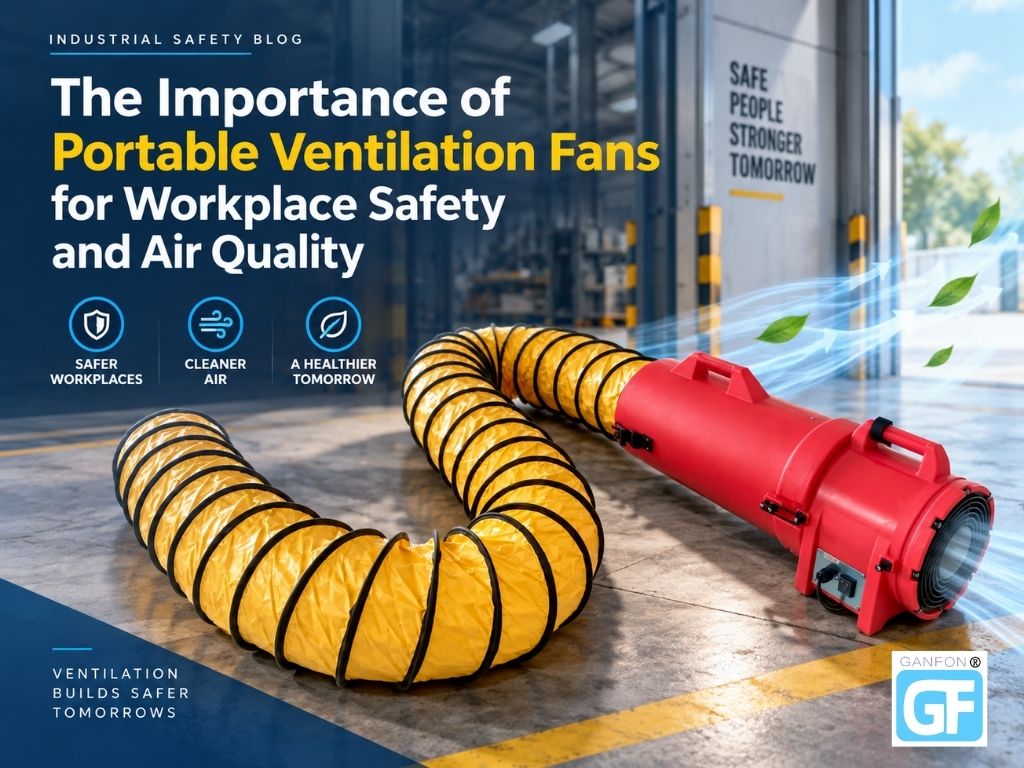
Industrial workplaces often face ventilation challenges that fixed building systems cannot completely address. Construction zones, workshops, warehouses, maintenance areas, temporary workspaces, and enclosed locations may all experience heat buildup, stagnant air, dust, fumes, odors, or inadequate air circulation.
In these situations, portable ventilation fans provide a flexible way to direct airflow where it is needed. Unlike permanent ventilation equipment, portable units can be repositioned according to changing work conditions and connected to flexible ducting when airflow needs to be directed into or out of a specific area.
For industrial buyers, workplace ventilation is not simply about making employees feel cooler. Proper airflow can support safer working conditions, improve air circulation, help manage heat accumulation, and create a more comfortable environment for daily operations.
Table of Contents
- Why Workplace Airflow Matters
- Supporting Safer Working Conditions
- Improving Air Quality Through Targeted Ventilation
- Reducing Heat Buildup in Demanding Work Environments
- What Industrial Buyers Should Consider When Selecting a Portable Ventilation Fan
- GANFON GB203 Portable Ventilation Fan
- Portable Ventilation Is About More Than Moving Air
- FAQ About Portable Ventilation Fans
- Choosing the Right Portable Ventilation Solution
Why Workplace Airflow Matters
Poor air circulation can affect both workers and production environments.
In factories, construction areas, workshops, and maintenance spaces, stagnant air may allow heat, odors, dust, or process-related airborne contaminants to accumulate around the work area. When ventilation is insufficient, working conditions may become increasingly uncomfortable and difficult to manage.
A portable ventilation fan provides targeted airflow without requiring permanent installation. It can be moved between work zones according to production schedules, maintenance requirements, or temporary ventilation needs.
This flexibility is particularly valuable for companies that operate across multiple or changing work areas rather than relying on a single fixed workstation.
Supporting Safer Working Conditions
Ventilation is an important part of workplace environmental control.
In enclosed or poorly ventilated areas, fresh-air circulation may be required before or during maintenance, inspection, construction, painting, cleaning, or other operations. A portable fan can help introduce clean outside air into the work area or direct stagnant air toward an appropriate exhaust location.
When connected to suitable ducting, a portable ventilation fan can also direct airflow farther into areas where a conventional floor fan may not provide sufficient reach.
Typical situations may include:
- Interior renovation areas
- Mechanical rooms
- Temporary construction zones
- Workshops and factories
- Warehouses
- Shipbuilding and steel fabrication environments
- Maintenance and repair locations
Portable ventilation should, however, be considered part of a broader workplace safety strategy.
Where hazardous gases, oxygen deficiency, combustible atmospheres, or regulated confined spaces are involved, ventilation equipment must be selected and operated according to applicable safety regulations, site-specific procedures, and equipment requirements. Forced ventilation does not replace atmospheric testing, continuous monitoring where required, respiratory protection, or other required safety controls.
Improving Air Quality Through Targeted Ventilation
General building ventilation does not always reach the exact location where workers are operating.
Grinding, cutting, welding, painting, cleaning, and maintenance activities may create localized dust, fumes, odors, or warm air. Increasing airflow around the work zone can help improve air circulation and reduce the accumulation of heat, odors, or airborne contaminants.
This is where portability becomes particularly useful.
Instead of increasing ventilation throughout an entire facility, operators can position a portable ventilation fan closer to the area that requires additional airflow.
For applications requiring ducted airflow, a portable ventilation fan can deliver clean air toward the work area or direct unwanted air toward an appropriate exhaust location.
However, where hazardous dust, welding fumes, chemical vapors, or other airborne contaminants are generated, general air movement should complement rather than replace suitable local exhaust ventilation (LEV) or source-capture equipment.
Reducing Heat Buildup in Demanding Work Environments
Heat is another common challenge in industrial workplaces.
Factories, warehouses, workshops, construction sites, and maintenance areas can become uncomfortable when machinery, weather conditions, limited ventilation, or enclosed structures cause heat to accumulate.
Portable ventilation fans increase air movement within the work area. While increased airflow does not necessarily lower the actual ambient temperature, improved circulation can help remove accumulated warm air and create a more manageable working environment.
This is particularly useful in temporary or changing locations where installing a permanent cooling or ventilation system may not be practical.
A portable unit can simply be relocated as operating requirements change.
For contractors, maintenance teams, and factories with multiple work zones, this mobility can be an important advantage.
What Industrial Buyers Should Consider When Selecting a Portable Ventilation Fan
Not every workplace can be ventilated effectively with the same fan.
Before selecting equipment, industrial buyers should consider how and where the unit will actually be used.
1. Airflow Reach
For larger work areas or locations where the fan cannot be positioned directly beside the operator, concentrated airflow and sufficient blowing distance become important.
Do not evaluate performance based only on fan diameter. Airflow design, motor performance, fan blade configuration, and duct resistance can all affect how effectively air reaches the target location.
2. Duct Compatibility
If air needs to be delivered into or extracted from an enclosed location, confirm whether the fan supports flexible duct connections.
Duct compatibility significantly increases application flexibility and can allow a portable ventilation fan to function as a targeted portable air blower.
3. Portability
A portable unit should be practical to transport between work areas.
Buyers should therefore consider:
- Overall dimensions
- Equipment weight
- Carrying handles
- Stand design
- Housing durability
- Ease of repositioning
For equipment that is moved several times during a workday, these factors can be just as important as maximum airflow.
4. Adjustable Air Direction
Different work areas require different airflow angles.
Adjustable positioning allows operators to direct air toward workers, equipment, work zones, openings, or duct connections without continuously repositioning the entire fan.
5. Operating Environment
Industrial equipment may encounter dust, moisture, impacts, transportation, and frequent repositioning.
The fan housing, motor, electrical design, and protective features should therefore be evaluated according to the actual operating environment.
6. Motor Reliability
The motor is an important factor influencing airflow performance and operating reliability.
For industrial buyers expecting frequent or extended use, motor construction and long-term performance should be considered alongside airflow specifications.
Related Reading: Portable Ventilation Fan vs. Traditional Exhaust Fan: Which Should You Use?
GANFON GB203 Portable Ventilation Fan
For customers requiring flexible airflow in industrial and commercial environments, GANFON offers the GB203 Portable Ventilation Fan.
The GB203 features an 8-inch fan driven by a single-phase induction motor and is designed to provide concentrated airflow with a maximum blowing distance of more than 15 meters.
Its airflow angle can be adjusted from 0° to 90°, giving operators greater flexibility when directing air toward different work areas.
The unit also supports external duct connections, allowing airflow to be delivered to specific areas or directed away from locations where direct fan positioning may not be practical.
Key characteristics include:
- More than 15 meters of blowing distance
- 0°–90° adjustable airflow angle
- Two-speed operation
- Portable construction
- External duct compatibility
- Support for air supply and exhaust applications
- Single-phase induction motor
For applications requiring temporary ventilation or concentrated airflow delivery, the GB203 can serve not only as a portable ventilation fan, but also as a practical portable air blower when used for targeted air supply or ducted ventilation.
This flexibility makes it suitable for workplaces where ventilation requirements regularly change from one area to another.
Portable Ventilation Is About More Than Moving Air
For industrial workplaces, ventilation equipment should be evaluated as part of the overall working environment rather than simply as another fan.
The right portable ventilation fan can provide airflow in locations that permanent systems cannot easily reach, support temporary ventilation requirements, improve air circulation, and help create more manageable working conditions.
For companies operating construction sites, factories, workshops, maintenance facilities, warehouses, or other demanding environments, portability provides an additional advantage: airflow can follow the work instead of requiring the work to remain near a fixed ventilation system.
When ducted air delivery is needed, a portable ventilation fan can provide additional flexibility by directing airflow toward specific areas or toward an appropriate exhaust location.
Related Reading: Portable Ventilation Fan Applications: Enhancing Safety and Airflow in Confined Spaces
FAQ About Portable Ventilation Fans
1. Can a portable ventilation fan be used for both air supply and exhaust?
If the equipment and duct configuration are designed for the purpose, portable ventilation fans can support both fresh-air supply and exhaust applications.
For example, ducting may be used to deliver outside air into a poorly ventilated location or move unwanted air away from the work area.
The actual setup should always be determined according to the workplace conditions and ventilation requirements.
2. Can portable ventilation fans be used in confined spaces?
Portable ventilation equipment is commonly used to support forced ventilation in tanks, tunnels, utility spaces, maintenance areas, and other locations with limited natural airflow.
However, a portable fan alone does not make a confined space safe.
Where regulated confined-space work is involved, employers should follow applicable procedures for hazard assessment, atmospheric testing, continuous monitoring, ventilation, communication, entry control, and personal protective equipment.
3. Can a portable ventilation fan replace a local exhaust ventilation system?
Not necessarily.
A portable ventilation fan is useful for improving general airflow, supplying clean air, helping move accumulated warm air, and supporting temporary ventilation.
Processes that generate hazardous fumes, fine dust, chemical vapors, or other contaminants may require dedicated local exhaust ventilation designed to capture contaminants close to their source.
The appropriate ventilation method should be determined according to the process and workplace hazard.
4. When should industrial buyers consider a duct-compatible portable ventilation fan?
Duct compatibility becomes particularly useful when:
- The fan cannot be placed directly beside the work area
- Air must reach an enclosed or restricted space
- Fresh air needs to be delivered from another location
- Hot or stagnant air needs to be directed away from the work zone
- Airflow needs to travel beyond the fan's immediate surroundings
For these applications, a duct-compatible portable ventilation fan can provide more targeted airflow than a conventional open-area fan.
Further Reading
-
Portable Ventilation Fan: How to Choose the Best One for Your Workspace
Learn what industrial buyers should evaluate when comparing portable ventilation fans for different workplaces. -
Portable Ventilation Fan vs. Traditional Exhaust Fan: Which Should You Use?
Compare portable and fixed ventilation approaches based on installation, mobility, airflow direction, and application requirements. -
Portable Ventilation Fan Applications: Enhancing Safety and Airflow in Confined Spaces
Explore how portable ventilation equipment can support airflow in restricted and poorly ventilated industrial work areas.
Choosing the Right Portable Ventilation Solution
Workplace ventilation requirements vary according to space size, operating conditions, airflow distance, ducting requirements, and working environment.
Before selecting a portable ventilation fan, industrial buyers should therefore consider not only airflow performance but also portability, airflow direction, motor reliability, durability, and duct compatibility.
GANFON develops motor-driven equipment for demanding industrial applications and provides ventilation solutions designed around practical workplace requirements.
If you are looking for a portable ventilation fan for industrial ventilation, temporary air circulation, targeted air supply, or exhaust applications, contact GANFON to discuss a suitable solution for your working environment.

