2026.10.16
Blog
Why Strapping Machine Motors Need High Starting Torque and Stable Cycle Performance?
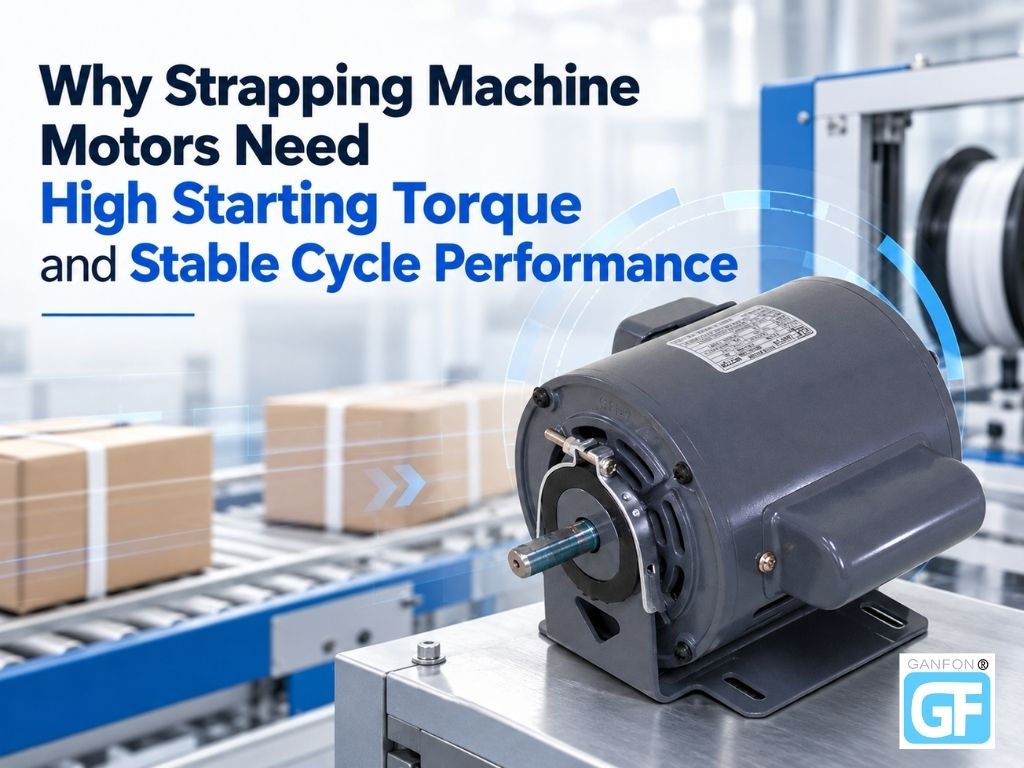
Automated strapping machines depend on fast, repeatable mechanical cycles to keep packaging lines running efficiently. During each cycle, the drive system may need to start, accelerate, feed the strap, tension it, complete the sealing sequence, and then reset for the next package.
Because of this repeated operating pattern, a strapping machine motor must do more than simply provide enough horsepower. It also needs sufficient starting torque, stable speed, reliable repeated-start performance, suitable thermal capacity, and mechanical compatibility with the packaging equipment.
For OEMs and packaging machine manufacturers, proper motor selection can directly affect cycle consistency, equipment reliability, and long-term operating stability.
Table of Contents
- Why Do Strapping Machines Need Specialized Motors?
- Why Is High Starting Torque Important for a Strapping Machine?
- Why Does Motor Stability Matter During Repeated Strapping Cycles?
- How Does Frequent Start-Stop Operation Affect Motor Temperature?
- Starting Torque vs. Horsepower: What Is the Difference?
- Common Strapping Machine Motor Problems and What to Check
- How to Choose a Motor for a Strapping Machine
- GANFON Single-Phase Induction Motor for Strapping Machines
- What Should OEMs Provide When Requesting a Custom Motor?
- FAQ About Strapping Machine Motors
- Choosing the Right Motor for Reliable Packaging Cycles
Why Do Strapping Machines Need Specialized Motors?
Strapping machines need motors that can repeatedly start, accelerate, operate under changing loads, and stop within short packaging cycles.
Unlike equipment that runs continuously at one steady load, many automatic strapping machines work through repeated operating sequences. The motor may need to overcome mechanical inertia at startup, drive rollers or transmission components, support strap tensioning, and then stop or reset before the next cycle begins.
This means the motor must be selected for the actual operating pattern of the machine, not just its rated horsepower.
Important requirements may include:
- Reliable startup
- Sufficient torque during acceleration
- Stable operating speed
- Repeated start-stop capability
- Acceptable temperature rise
- Compact installation
- Low vibration
- Long-term operating reliability
A motor that appears adequate on a specification sheet may still perform poorly if its torque and duty characteristics do not match the machine.
Why Is High Starting Torque Important for a Strapping Machine?
High starting torque helps a strapping machine motor overcome inertia and mechanical resistance when the machine starts each operating cycle.
Starting torque is the rotational force available as the motor begins accelerating from standstill.
In a strapping machine, the motor may need to quickly drive belts, gears, rollers, tensioning mechanisms, or other transmission components. If resistance is relatively high at startup, insufficient torque may result in slow acceleration or unstable machine operation.
Adequate starting torque can help:
- Improve startup reliability
- Shorten acceleration time
- Reduce slow or incomplete starts
- Support repeated packaging cycles
- Handle changes in mechanical resistance more effectively
GANFON describes its strapping machine motor solutions as requiring high torque and fast-start characteristics so packaging equipment can complete operating cycles efficiently and maintain stable overall performance.
Why Does Motor Stability Matter During Repeated Strapping Cycles?
Stable motor performance helps a strapping machine repeat the same operating sequence with more consistent timing and mechanical response.
In automatic packaging equipment, repeatability is critical.
If motor speed or torque varies significantly from one cycle to another, the connected mechanical system may also behave differently. This can affect strap feeding, tensioning, timing, and the overall rhythm of the packaging process.
Stable motor performance can support:
- More consistent cycle timing
- More predictable strap feeding
- Stable tensioning behavior
- Reduced vibration
- Smoother mechanical operation
- More repeatable packaging performance
For automated production lines, this consistency can be just as important as maximum motor output.
How Does Frequent Start-Stop Operation Affect Motor Temperature?
Frequent start-stop operation can increase motor temperature because each startup places greater electrical and thermal stress on the motor than normal running conditions.
An induction motor typically draws more current during startup than during normal operation.
If a packaging machine starts repeatedly before the motor has enough time to dissipate heat, temperature can gradually accumulate.
For this reason, motor selection should consider:
- Starts per hour
- Packaging cycles per minute
- Running time during each cycle
- Idle time between cycles
- Mechanical load during startup
- Ambient temperature
- Cooling conditions
- Motor enclosure design
A motor suitable for occasional operation may not necessarily be suitable for high-frequency packaging equipment.
This is why duty cycle and start frequency should be evaluated before the motor specification is finalized.
Starting Torque vs. Horsepower: What Is the Difference?
Starting torque determines how effectively a motor accelerates the machine from standstill, while horsepower describes the motor's mechanical output during operation. Higher horsepower does not automatically mean higher starting torque.
This distinction is important when selecting a motor for a strapping machine.
Two motors may have similar horsepower ratings but behave differently during startup because their torque characteristics, winding design, speed, and electrical configuration are different.
For packaging equipment, motor selection should therefore consider both:
- The power required during normal operation
- The torque required during startup and load changes
Simply installing a larger motor is not always the best solution.
An oversized motor may increase equipment size, weight, cost, or installation difficulty without necessarily solving the actual starting or cycle-performance problem.
The better approach is to match the motor to the machine's real load profile.
Common Strapping Machine Motor Problems and What to Check
Problems such as slow startup, overheating, irregular speed, or frequent protection trips can indicate that the motor and machine operating conditions are not properly matched.
However, these symptoms do not automatically mean the motor itself is defective.
The transmission system, electrical supply, machine adjustment, bearings, belts, gears, and mechanical resistance should also be inspected.
| Symptom | Possible Effect | What to Check |
|---|---|---|
| Slow startup | Longer packaging cycle | Starting torque, voltage, mechanical load |
| Motor struggles under load | Unstable machine movement | Torque requirement, transmission resistance |
| Motor overheats | Reduced motor life | Start frequency, cooling, load, duty cycle |
| Irregular speed | Inconsistent machine timing | Load variation, motor specification, voltage |
| Frequent protection trips | Production interruptions | Overload, supply voltage, thermal condition |
| Excessive vibration or noise | Increased mechanical wear | Alignment, mounting, bearings, transmission |
This type of troubleshooting is more effective when the motor is evaluated together with the complete machine rather than as an isolated component.
How to Choose a Motor for a Strapping Machine
A suitable strapping machine motor should be selected based on the machine's startup condition, operating load, cycle frequency, electrical supply, transmission design, and installation space.
How Much Starting Torque Does a Strapping Machine Motor Need?
The required starting torque depends on how much mechanical resistance the motor must overcome when the machine begins moving.
Equipment with heavier rollers, tighter transmission systems, higher inertia, or greater tensioning resistance may require more starting torque.
The motor should provide enough torque to start reliably without remaining in the high-current startup condition for too long.
How Should Motor Output Be Matched to the Machine?
Motor output should match the actual operating load of the strapping mechanism.
An undersized motor may operate under excessive stress, while unnecessary oversizing can increase cost and installation size.
The correct selection should be based on actual operating conditions rather than horsepower alone.
What Motor Speed Is Suitable for a Strapping Machine?
Motor speed should match the transmission ratio and required packaging cycle.
GANFON's current Single-phase Induction Motor for Strapping Machine lists speeds of 1400 RPM at 50 Hz and 1700 RPM at 60 Hz.
The final machine speed will also depend on:
- Pulley ratio
- Gear reduction
- Roller diameter
- Transmission design
Motor RPM should therefore always be evaluated together with the mechanical system.
How Do Voltage and Frequency Affect Motor Selection?
Voltage and frequency must match the machine's electrical system and destination market.
Different markets may use different power standards, so OEMs should confirm electrical requirements during the equipment design stage rather than after the machine is completed.
How Does Cycle Frequency Affect Motor Selection?
Frequent operating cycles increase repeated-start demand and thermal loading.
A machine that operates intermittently may require different motor characteristics from one that cycles many times per minute or operates for long production periods.
The expected cycle frequency should therefore be included in the motor specification.
Why Does Installation Space Matter?
Packaging equipment often has limited internal space.
Motor dimensions, shaft position, mounting points, housing geometry, and transmission alignment can all affect whether the motor can be integrated into the machine efficiently.
A compact motor configuration can provide greater flexibility for OEM equipment design.
Why Are Cooling and Durability Important?
Repeated operation generates heat.
Adequate cooling helps control temperature buildup, while durable materials and mechanical construction support long-term operation.
For packaging machines that operate for extended production periods, thermal performance should be considered together with torque and power.
Why Should Noise and Vibration Be Considered?
Excessive vibration can affect both motor life and machine stability.
Packaging equipment is commonly installed in factories, logistics centers, warehouses, and production lines, where smoother operation can contribute to more predictable machine behavior and a better working environment.
GANFON Single-Phase Induction Motor for Strapping Machines
GANFON offers a single-phase induction motor specifically developed for strapping and packaging machinery that require stable output and repeated operating cycles.
The currently listed product specification includes:
| Specification | GANFON Strapping Machine Motor |
|---|---|
| Motor Type | Single-phase induction motor |
| Poles | 4P |
| Output | 1/3 HP |
| Voltage | 220–240 V |
| Frequency | 50 / 60 Hz |
| Speed | 1400 / 1700 RPM |
| Application | Strapping and packaging machinery |
The product description also indicates that 1/3 HP or 1/2 HP output configurations can be used for different automatic packaging machinery requirements.
Key characteristics highlighted by GANFON include:
- Low-speed, high-torque design: Supports applications that require torque during packaging operation.
- Low starting current: Designed to support efficient startup performance.
- Stable operation: Helps support repeated packaging cycles.
- Compact iron housing: Optimizes motor size and improves installation flexibility.
- Optimized cooling: Supports long-term operation.
- Low-noise operation: Suitable for indoor equipment applications.
- Customized specifications: Motor specifications can be adjusted according to application requirements.
For OEMs, customization is particularly important because strapping machines may differ in transmission ratio, mechanical load, packaging speed, installation space, shaft requirements, voltage, frequency, and operating cycle.
A motor designed around the actual machine operating conditions is generally more suitable than selecting one based only on a standard horsepower rating.
Learn more about GANFON's Strapping Machine Motor Solutions.
What Should OEMs Provide When Requesting a Custom Motor?
Providing actual machine operating data helps the motor manufacturer evaluate a configuration that better matches the strapping machine.
Useful information may include:
- Required motor output
- Voltage
- Frequency
- Required motor speed
- Expected starting load
- Packaging cycles per minute
- Starts per hour
- Transmission ratio
- Shaft dimensions
- Mounting dimensions
- Available installation space
- Ambient temperature
- Expected daily operating hours
The more accurately the machine conditions are described, the easier it is to evaluate torque requirements, thermal performance, and mechanical compatibility before the motor is integrated into the equipment.
FAQ About Strapping Machine Motors
1. Can a Single-Phase Induction Motor Be Used for an Automatic Strapping Machine?
Yes, depending on the machine design, required output, operating cycle, and available power supply.
Single-phase induction motors can be suitable for packaging equipment where single-phase power is available and the motor's torque, speed, and thermal characteristics match the machine requirements.
GANFON provides single-phase induction motor solutions specifically for strapping and packaging machinery.
2. What Causes a Strapping Machine Motor to Overheat?
Motor overheating can result from excessive mechanical load, frequent starting, insufficient cooling, voltage problems, incorrect motor sizing, or increased resistance within the transmission system.
Possible causes include:
- Excessive starts per hour
- Overloaded transmission components
- Poor ventilation around the motor
- Abnormal supply voltage
- Worn bearings or increased mechanical resistance
- Incorrect motor output or duty selection
Because overheating can originate from either the motor or the driven mechanism, the complete machine should be checked before replacing the motor.
3. Can a Strapping Machine Motor Be Customized for an OEM Machine?
Yes. Motor specifications can be adjusted according to the mechanical and electrical requirements of the packaging machine.
Depending on the project, customization may involve:
- Motor output
- Voltage and frequency
- Operating speed
- Shaft dimensions
- Mounting configuration
- Motor dimensions
- Starting and torque characteristics
- Wiring or electrical configuration
For OEM projects, providing the actual machine load, operating cycle, transmission design, and installation dimensions helps the motor manufacturer evaluate a more suitable configuration.
Further Reading
-
Top Applications of Single-Phase Induction Motors in Industrial and Commercial Equipment
Learn how single-phase induction motors are used in strapping machines, air compressors, blowers, pumps, water purification equipment, and other industrial applications. -
Top 5 Industrial Applications of AC Induction Motors
Explore how AC induction motors support packaging lines, conveyors, material handling systems, machine tools, and other industrial equipment. -
What Factors Affect the Lifespan of an Induction Motor?
Understand how operating load, temperature, power conditions, working environment, and maintenance can influence long-term motor reliability.
Choosing the Right Motor for Reliable Packaging Cycles
The right strapping machine motor must match the complete operating cycle—not just the horsepower requirement.
Starting torque, cycle frequency, operating speed, thermal conditions, voltage, installation space, and mechanical load all influence how reliably the packaging machine performs.
For OEMs, evaluating these factors during the design stage can help reduce unstable startup, excessive heat, inconsistent cycle timing, and unnecessary equipment downtime.
GANFON develops induction motor solutions for strapping machines and other automated packaging equipment, with customization available for different machine requirements.
If you are developing a new strapping machine or reviewing an existing motor specification, contact GANFON to discuss your machine's operating conditions and suitable motor specifications.

